Tom Patton
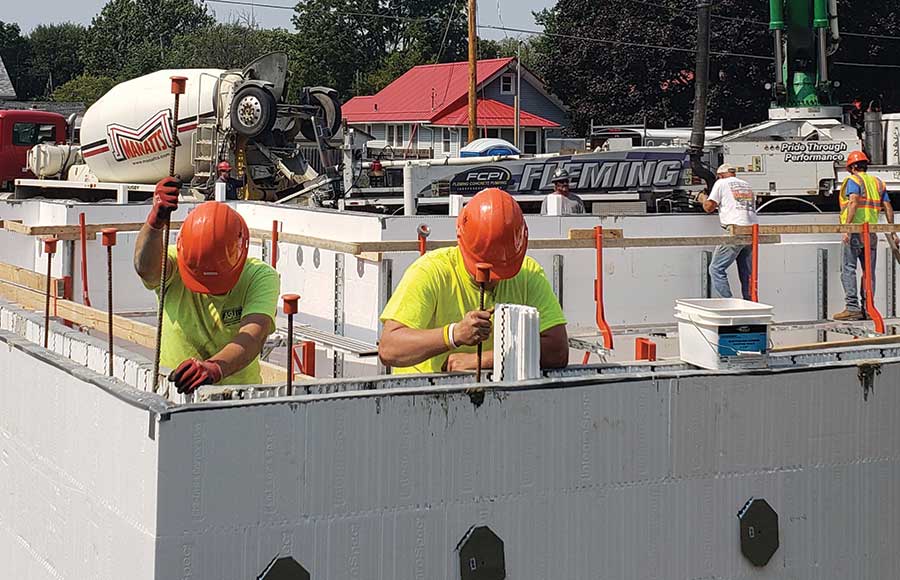
Placing concrete in ICF walls is typically not a familiar job for anyone building with ICFs for the first time. This process can be an intimidating step in the ICF building process, especially for new contractors or DIYers, although it doesn’t have to be.
- First, the forms are manufactured to withstand the pressure of the concrete placement.
Second, following ICF installation procedures, necessary bracing, and strapping have been applied.
Third, the concrete specifications have a high slump rate of 5 to 6 inches, which allow it to flow smoothly into the cavity.
Fourth, concrete is placed in consecutive lifts (around perimeter at a lift height of 4 feet)
Fifth, the recommended method for placement is with a controlled flow rate from a concrete pump truck. The pump truck operator is your best friend with a lot of experience.
Concrete pumping has changed the way contractors place concrete. Rather than hauling wheelbarrows, man-handling buckets, or organizing line chutes, a pumper is efficient, fast, and less labor intensive. The decision to hire a pump truck is generally a budgeting factor. To save money, the contractor may assume that the labor involved without a pumper will be cheaper, but after doing this work, everyone realizes the time and effort is not worth it. Utilizing the pump truck and the skill of the operator allows for faster placement, high quality control, more crew coordination, and less manpower.
Boom and Line Pumps
Two main types of concrete pumps are used across the industry: boom pumps and line pumps.
Boom Pumps
Boom pumps are mounted on trucks and feature a multi-section robotic arm that can generally extend to every corner of the project or up multiple stories. These are the preferred choice for all sizes and building types. Their reach often spans more than 100 feet, and some models exceed 200, making them efficient for any residential project and essential for mid- to high-rise construction.
Line Pumps
Line pumps operate using flexible hoses or rigid pipes that can be routed through tight site conditions. These are common on residential foundations, interior pours, and renovation work. Output rates vary, typically 30 to 90 cubic yards per hour, depending on pump size and line length. Their compact footprint and fast setup — often under an hour — make them ideal for urban sites or properties with minimal access. Line pumps may be ideal for use on ICF low height walls — stem walls, crawl spaces, and grade beams.
Setup Procedures for Concrete Pump Truck
The site must be organized with a clear area for the pump truck and access for concrete trucks. The ground must be reasonably level and sound to support both heavy trucks. The boom needs to be clear of overhead obstructions — trees, power lines, etc. The pump truck will have outriggers to stabilize the vehicle so take that into account as well.
The location should be such that the truck’s boom reaches all walls and corners of the building and does not have to move during placement. Allow a good hour for the pump truck to get setup and ready before the concrete arrives. The operator uses a remote control and will most likely walk around the project as the concrete is placed. It is very important to communicate with the pump operator and understand safety factors and communication signals.
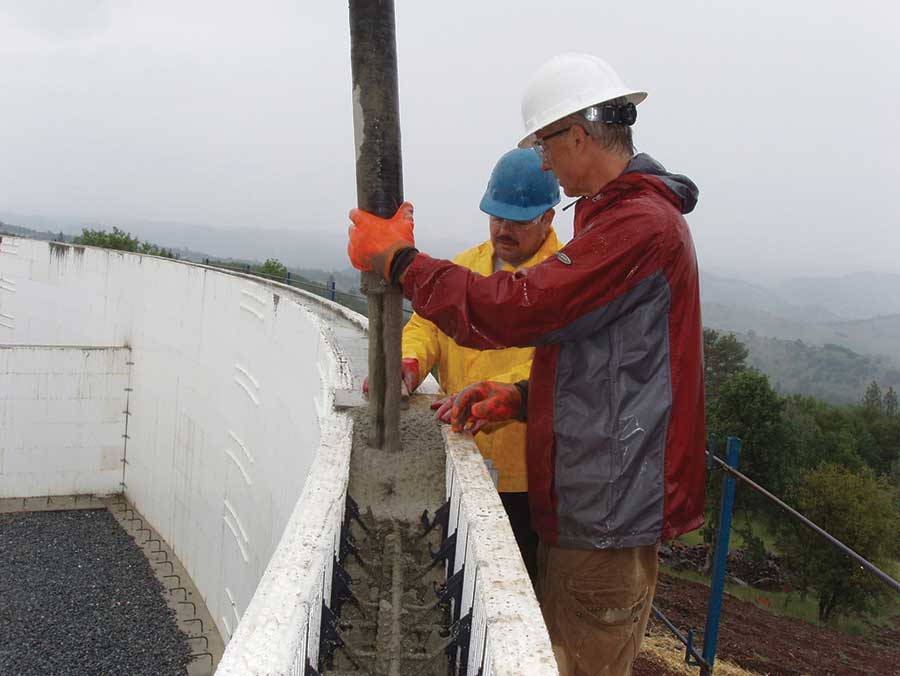
IntegraSpec’s Nicholas Nikiforuk pouring concrete for the Casa Bella Verde home in Northern California. The home used about 1,800 yards of concrete.
Safety and Getting Started
Lean on the experience of the pump operator to help make the following decisions:
- Have one member of the crew responsible for placing concrete and communicating stop, go, directions, etc. with the pump operator.
- Decide where to start placement on the wall.
- Understand flow rate. The hose should have a reducer to control velocity and reduce internal surge within the ICF cavity.
- Understand the lift height limits, placement in window sills and lintels, and any other tricky spots in the wall layout.
- Ensure there is a clear walking path around the project for continuous placement.
- Assign one or two crew members to follow placement with the vibrator to ensure consolidation.
- For safety, everyone must be aware of staying out from under the boom.
Placement
Wall height dictates the number of lifts. Typically, a lift in ICFs is limited to around 4 feet. So, if the wall height is 8 feet to 9 feet, you could have two lifts. This means you go around the whole perimeter twice. Generally, before the second lift, the first lift has approximately one hour for the concrete to set up and support the second lift. If the walls are higher, divide the wall height by 4 for the number of lifts. The general rule is allowing one hour to do each continuous lift. In the calculations, the top lift should be at least 3 feet to 4 feet deep. Any less is hard to control splashing of concrete.
The pump operator has control to start and stop the flow of concrete. You control the pump operator by signalling him to start or stop the flow. If at any time you encounter a problem, stop the flow.
The concrete slump for ICFs will
allow it to flow in the wall cavity. As the concrete is placed, move along the wall, filling as you go. Always be watching the flow of concrete in the cavity, monitoring for any blockages that could create voids and possible blow-outs.
The placement of concrete is the most important part of the ICF wall assembly and can not be taken lightly, as the concrete is the structural element of the building. If, as a first time ICF builder, you are hesitant to place the concrete, hire an experienced installer for the day to do the work for you and teach you the techniques. Like everything else, follow the procedures, safety rules, and advice of the pump operator, then, the job will go smoothly.

Tom Patton
Tom Patton had a 30-year architectural design background prior to joining the ICF industry in 2001 with the technical support department at ARXX. Over the last 20 years, Tom has worked with major ICF companies developing technical documentation, application details, and training programs, as well as consulting and promoting ICFs with various associations including the ICFMA, NRMCA, and codes and standards committees. Currently, Tom is Corporate Brand Ambassador for Fox Blocks and co-developer of the Fox Blocks Integrated Learning Center.