By Tom Patton
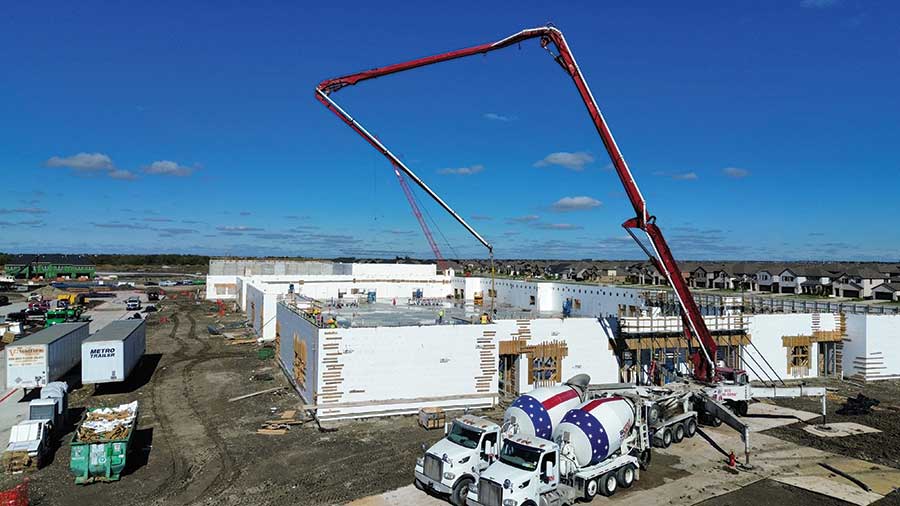
Construction of an ICF school in Prosper, Texas. This school district has 16 ICF schools.
Photos courtesy of Fox Blocks by Airlite Plastics Co.
In November 2025, this magazine published a key article about the rise in popularity of ICF commercial construction. It was called “Commercial ICF Construction Surges Across All Building Sectors,” and it was provided by me on behalf of the ICF Manufacturers Association (ICFMA). [Read it here: https://icfmag.com/2025/10/commercial-icf-construction-surges-across-all-building-sectors]
This topic is still relevant today as more and more major building projects are being designed and built with ICFs. This is a transition from masonry construction due not only to all the advantages provided by an ICF block — which include speed of construction, smaller crews, and the easy training needed to learn ICF installation. ICF installation is a natural transition for a mason used to building walls. Plus, as a masonry contractor using ICFs, there are additional savings on builder’s risk insurance.
A commercial-grade masonry contractor’s basic prerequisites for bidding are materials, labor, scheduling, scaffolding and bracing, permits, and site access. In each of these areas, ICFs give a masonry contractor the opportunity to outperform traditional methods. ICF materials are readily available across the country. One ICF standard block is 5.3 square feet of wall area and is lightweight. The man-hour labor rate to install any commercial ICF wall has been documented at less than 0.080. This expedites the building envelope completion dates by three to four weeks or more compared to masonry, while using a smaller crew.
Commercial masonry contractors have existing scaffold systems that may be enhanced to provide bracing and alignment for ICF walls. ICF manufacturers can assist with scaffolding, straight backs, turnbuckles, and various attachments along with training on how to achieve attachments and wall alignment.
Masonry construction has been shaped by a shortage of skilled masons, as fewer members of the younger generation are entering the trade. The handling of heavy blocks, especially 12-inch blocks, moving, transferring to the wall area, and laying the blocks requires a lot of effort throughout the work day. In comparison, an ICF block is 16 inches by 48 inches and weighs only 7 pounds. Transporting and handling ICFs is easy, with straight and corner reversible blocks uniquely enhancing efficiency.
The attributes of ICFs in the commercial market sector meet and exceed structural design requirements to allow for above- and below-grade walls, load-bearing walls, shear walls, fire-rated walls, tall walls (40 feet and more), and multi-story buildings. Generally, as a structural wall, the reinforced concrete core may be thinner than the overall CMU size. The placement of horizontal and vertical rebar is easily accommodated in ICF forms. ICFs have a wide range of concrete core sizes, block types, and accessories including window bucks, spray foam, clips, brick ties, and more.
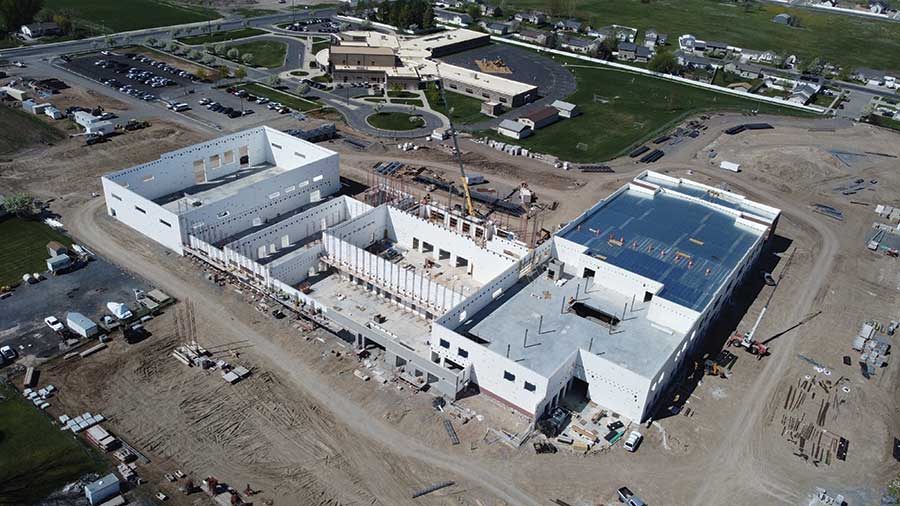
Construction of an ICF school in Logan, Utah.
Every project requires material estimates and production rates, sequencing, and integration requirements. Masonry contractors can follow the same methodology for material estimating to calculate for ICF walls and materials. Most of the commercial ICF manufacturers have estimating programs and/or commercial advisors (CAs) to assist in the estimating and bidding process for first-time and ongoing mainstream masonry contractors. Advanced production rates compared to CMU necessitate updating sequencing requirements with other trades.
Structural integration with floors and roof systems have been continually designed and developed for ICF wall assemblies with common and repetitive detailing. Structural connections, embed plates, point loads, and sidewall connections are all common design attributes for an ICF. Commercial storefronts, windows, curtain walls, and finishes are all compatible with ICF wall assemblies. Fire-rated wall assemblies for interior demising walls, corridors, etc. may all be built with ICF block. Even elevator and stairwell towers are regularly designed with ICF walls.
Commercial-grade ICF training, either online or in-person to project-specific needs, is available upon request. The skill level for masonry installation is an advantage in the easy transition to ICFs. Manufacturers provide certified contractor training to educate your crew on the techniques and efficiencies to install ICFs. CAs are available to assist in converting CMU designs to ICF. They streamline the process by providing value-added ICF design and detailing, and by helping write ICF specifications. Some ICF manufacturers will assist in doing the estimate and material orders per truckload to maximize shipping efficiencies.
ICF manufacturer CAs provide project analysis, advice on efficiencies, general competitive bid rates, estimating hard costs, allowable margins, and project-specific bid assistance including all aspects of an ICF turnkey installation.
Architects, engineers, and developers are reviewing project reports and construction analysis for all building types built with ICFs, which include schools, hotels, theaters, data centers, community centers, retail, and others. These reports show expedited completion times, fewer deficiencies, cleaner and safer job sites, plus the other advantages of ICFs for resiliency, energy efficiency, and sustainability.
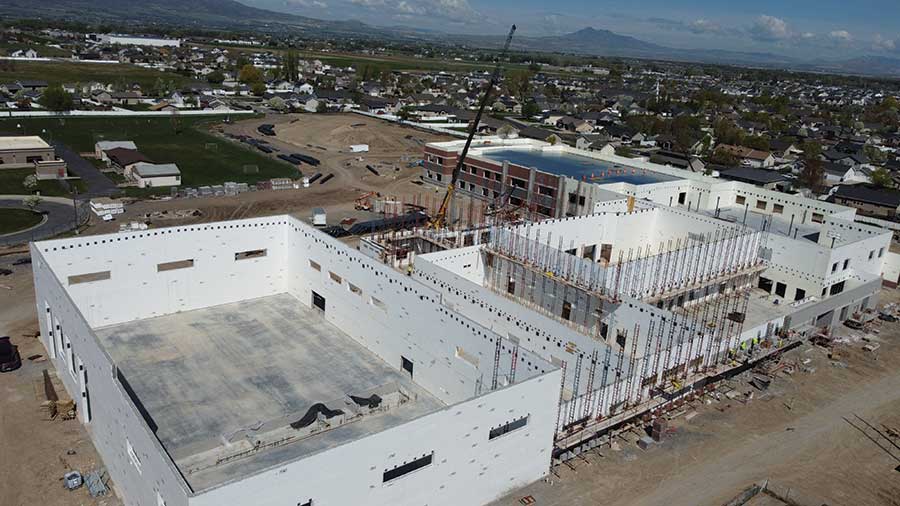
The school district in Logan, Utah, has five ICF schools so far.
As a big plus, the ICF manufacturer has marketing efforts that can support the contractor by promoting the project and the contractor with videos, project pictures, posts, and social media shout-outs, not to mention submissions into award programs.
In today’s business world, ICF commercial bidding can improve and expand your business, increase profits, and add to your company’s profile. As a commercial-grade masonry contractor, having the versatility to bid on CMU or ICF projects is a major transition into the modern construction marketplace. Adding more skills to your crew and having the ability to market improved construction speed, resiliency, and sustainability is possible through the experience of working with an ICF manufacturer’s CA, by bidding confidently, and building efficiently with ICFs.
The commercial ICF market is expanding rapidly; ICF manufacturers working closely with new masonry subcontractors always recognize that folks learning something new is a hill to climb. To streamline that is a huge point of pride and satisfaction. Let the ICF industry help you and bring you opportunities to expand your business.
Check out the major ICF manufacturers on the ICFMA website [https://icf-ma.org], for products, guidelines and training.

Tom Patton
Tom Patton had a 30-year architectural design background prior to joining the ICF industry in 2001 with the technical support department at ARXX. Over the last 20 years, Tom has worked with major ICF companies developing technical documentation, application details, and training programs, as well as consulting and promoting ICFs with various associations including the ICFMA, NRMCA, and codes and standards committees. Currently, Tom is Corporate Brand Ambassador for Fox Blocks and co-developer of the Fox Blocks Integrated Learning Center.