By Trevor Brown
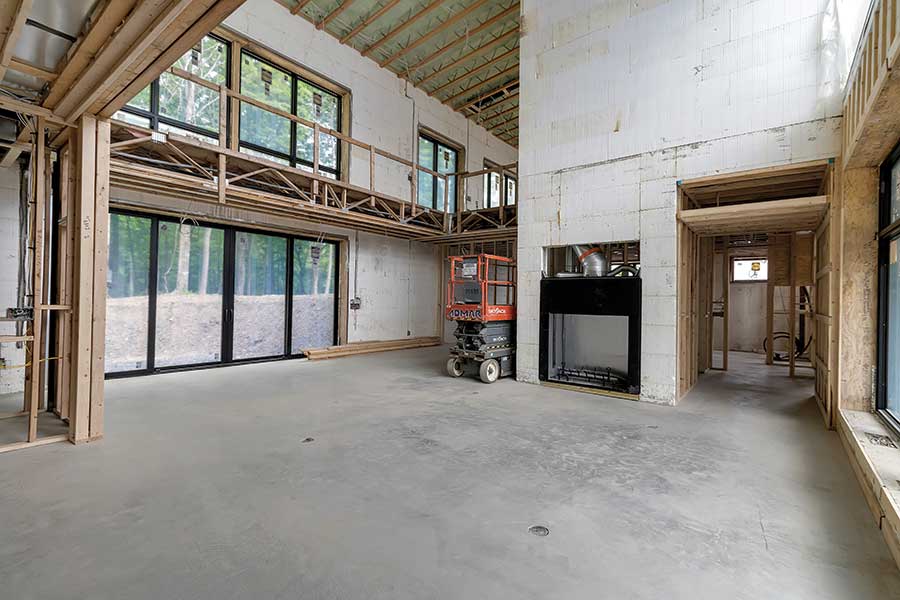
The Miller Residence in East Aurora, New York, was the winner in the Large Residential category of the 2026 ICF Builder Awards. Photo courtesy of Amvic by Alleguard
In 2026, “green building” is no longer a marketing layer. It’s a performance mandate. Owners are scrutinizing operating costs. Municipalities are tightening energy codes. Lenders and insurers are evaluating resilience. And design teams are being asked to document both operational and embodied carbon with real data. For trade professionals, that means one thing: Systems matter more than ever.
ICFs are among the systems gaining traction in serious green projects, especially when paired with optimized concrete mixes and corrosion-resistant GFRP (glass fiber–reinforced polymer) rebar. Together, they represent a high-performance stack that addresses energy efficiency, durability, lifecycle cost, and long-term carbon impact.
Recently, I was in South Florida talking to some multifamily and commercial real estate investors, and much of the discussion was about resilience and innovation. These topics aren’t trends. It’s about buildable, scalable performance.
The Shift to Lifecycle Thinking
A decade ago, green building largely revolved around operational efficiency, meaning reducing HVAC loads, upgrading insulation, and adding better windows. That’s still critical. But the conversation has broadened significantly. Now it’s about energy use over the building’s life, durability and service life, material production, and construction impact. As the folks in Key Largo told me, resilience to extreme weather, maintenance cycles, and repair frequency has become a true decision-making matrix. Another discussion topic is indoor air quality and moisture management, since the concept of healthy homes is becoming more popular every year.
The modern sustainability equation isn’t about eliminating a single material. It’s about optimizing the full lifecycle. The most sustainable structure is one that performs efficiently for decades without major structural intervention. That’s where ICF systems dominate.
ICFs are the Best Structural and Thermal System
ICFs combine structure and insulation, creating a continuous thermal envelope with a structural core. For builders and engineers, this integration reduces complexity while improving performance in three key areas:
- Continuous Insulation and Reduced Thermal Bridging
Unlike many framed assemblies that rely on cavity insulation interrupted by studs, ICF walls provide continuous insulation on both sides of the concrete core. This reduces thermal bridging and helps projects meet increasingly strict energy code requirements.
In practice, this often translates to lower heating and cooling loads, more consistent interior temperatures, and easier compliance with energy modeling targets. For commercial and multifamily projects especially, envelope performance is often the difference between passing or failing modeled benchmarks. This will put you light-years ahead of aggressive energy codes anywhere you are building. - Thermal Mass and Load Moderation
The concrete core in ICF construction provides meaningful thermal mass. In climates with daily temperature swings, this mass effect helps moderate interior temperature fluctuations, reducing peak HVAC demand. In 2026’s grid environment — where peak demand charges and grid stress are growing concerns — this load smoothing has both economic and sustainability value. - Airtightness and Enclosure Simplicity
Air leakage remains one of the most common performance failures in conventional construction. Multi-layer assemblies require precise coordination between trades. ICF assemblies simplify the enclosure with fewer layers, fewer transitions, clear structural continuity, and improved potential for blower door performance. A tighter envelope allows mechanical systems to operate as designed. It also improves humidity control and indoor air quality when paired with proper ventilation strategies. Not to mention the reduction of subs needed.
Concrete and the Low-carbon Discussion
Concrete’s embodied carbon, which is primarily tied to cement production, often draws scrutiny. However, 2026’s green construction landscape is far more nuanced than material elimination. Concrete is evolving. Have you heard about Optimized Mix Designs and SCM Integration? I will be honest…. I hadn’t until I was doing research for this article. Supplementary Cementitious Materials (SCMs) such as slag cement and fly ash reduce cement content while maintaining strength and durability.
Blended cements and performance-based specifications are increasingly common. What does that mean? For trade teams, this means concrete specified by performance metrics, not just compressive strength. It means reduced cement content where structurally appropriate and documented Environmental Product Declarations (EPDs) supporting carbon accounting. When paired with ICF construction, lower-carbon concrete strategies allow teams to address embodied carbon while delivering a high-performance envelope. I know, I’m learning too… but this is becoming more important to large scale developers and investors.
Durability as Carbon Reduction
A frequently overlooked aspect is repair and replacement. Concrete structures with long service lives and minimal intervention requirements often outperform lighter systems that require major envelope replacement over time. We are seeing a huge push in disaster areas for this. Sustainability professionals increasingly recognize durability as a carbon strategy. A structure that avoids major remediation for 50 to 75 years has a dramatically different lifecycle profile than one requiring recurring structural repair. We need to keep our structures out of the landfill! We have all seen the destruction a disaster causes. Now imagine the impact of disposing of all of those materials.
GFRP Rebar: Corrosion Resistance and Lifecycle Performance
Reinforcement decisions are increasingly part of the sustainability conversation. Traditional steel rebar is well-understood and effective. However, corrosion remains a primary cause of long-term structural repair in many exposure environments, particularly in coastal regions, cold climates with de-icing salts, or chemically aggressive conditions. GFRP rebar addresses this challenge directly.
GFRP reinforcement does not corrode in the same way as steel. In moisture- or chloride-prone environments, this can significantly reduce cracking, spalling, and long-term repair cycles. Reduced maintenance and repair carbon is an issue.
Structural rehabilitation carries its own material and carbon footprint. Reducing corrosion-driven intervention lowers lifecycle impact.
GFRP is substantially lighter than steel, reducing transportation energy and simplifying handling on site. For certain project types, this can also improve labor efficiency.
As with any structural material, engineering design and code compliance are critical. But from a lifecycle perspective, corrosion resistance aligns directly with sustainability goals focused on service life extension.
The Overlooked Green Metric: Resilience
In 2026, resilience is inseparable from sustainability. Wildfire exposure, extreme wind events, flooding, and temperature volatility are influencing insurance markets and municipal standards. Buildings that withstand these stresses without catastrophic failure reduce reconstruction waste and long-term carbon impact. ICF assemblies offer high structural strength, resistance to rot and pest damage, and reduced moisture vulnerability compared to some cavity wall systems. They offer strong wind and impact resistance when properly engineered. A resilient structure avoids demolition and rebuild cycles, which are the most carbon-intensive outcome possible.
Indoor Environmental Quality and Moisture Control
Green building performance is not limited to energy and carbon. Indoor environmental quality (IEQ)or indoor air quality (IAQ) plays a major role in certification systems and occupant expectations. I have had many people reach out in recent years asking me about “healthy homes.” A lot of people are concerned with the quality of air they are breathing inside their homes. Covid made us very aware of airborne toxins. ICF construction can support IEQ goals by reducing uncontrolled air leakage, minimizing moisture accumulation within wall cavities, and supporting stable interior humidity when mechanical systems are properly designed.
Noise Control
I believe one of the most under-appreciated benefits of ICF is sound! Providing acoustic dampening benefits is among the first things ICF dwellers like me will bring up when they talk about the benefits of living in an ICF home. For multifamily, hospitality, and commercial projects, acoustic control and comfort are increasingly valuable selling points.
However, airtight buildings must incorporate properly designed ventilation systems. ICF performance is maximized when integrated with intentional mechanical design.
Build-Ability and Trade Coordination
One of the biggest barriers to green adoption is perceived complexity. Any time you have to change what you do every day, you will feel “inconvenienced.” I get it. But we can’t keep doing it the same way we have always done it. There are better ways to do it.
ICF systems reduce envelope-layer coordination and can streamline sequencing in many applications. For trade professionals, this can mean reduced risk of insulation gaps, fewer thermal bridge corrections, simplified inspection processes, and predictable structural performance. As labor markets remain tight in many regions, systems that reduce error potential and rework are strategically valuable.
Ok, So How Do I Do It?
For trade teams pursuing high-performance construction, the integration of ICF structural-envelope systems means a few things: a new envelope structure; optimized, lower-carbon concrete mixes; and maybe corrosion-resistant GFRP reinforcement. But together, they address operational energy reduction, carbon transparency, and long-term durability. Down the road, you have reduced maintenance cycles and resilience under extreme conditions. The end result is improved occupant comfort and a system-based approach aligning with emerging green financing requirements, insurance scrutiny, and performance-based codes.
In Conclusion
In 2026, sustainability is measured, documented, and verified. Owners and municipalities are less interested in buzzwords and more focused on long-term performance. Insulated Concrete Forms, combined with optimized concrete and corrosion-resistant reinforcement, represent a practical, scalable pathway to meet modern green expectations.
For trade professionals, the value proposition is clear:
Build once. Build tight. Build durable. And build for the lifecycle!

Trevor Brown
Trevor Brown is the owner and operator of Innovative Building Products, a multiline ICF and ICF accessories distribution company. He has been in the ICF industry for more than 20 years, starting as an installer and distributor. He has managed the Western U.S. for an industry-leading ICF company and is now an independent consultant for ICF builders and homeowners across the country. He is also the co-host of the Build With ICF Podcast, which can be found on the website www.buildwithicf.com.