By Trevor Brown, Founder and CEO, World Insulated Concrete Form Association
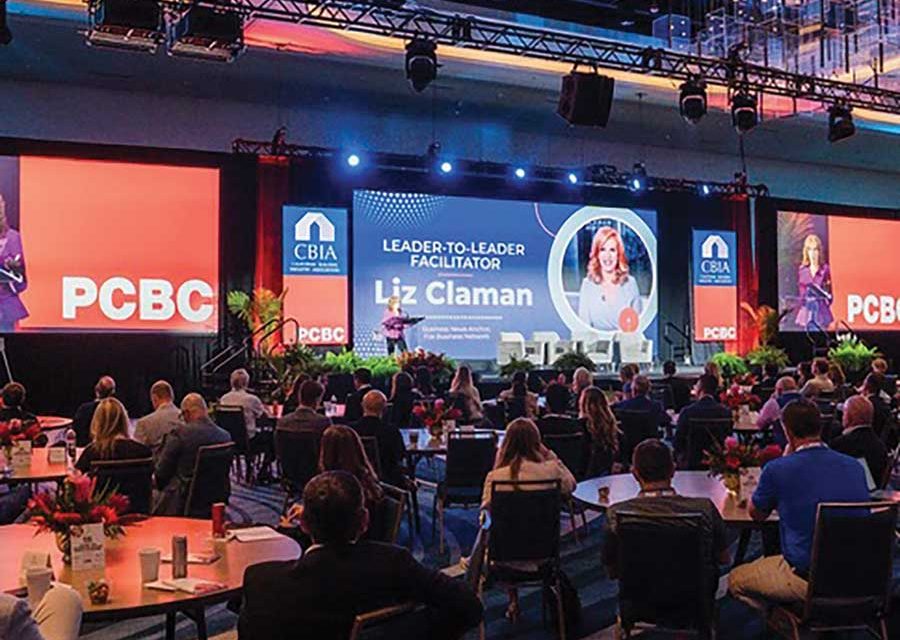
I recently traveled to San Diego, California, for the Pacific Coast Builders Conference, better known as PCBC. As one of the premier gatherings for builders, developers, architects, manufacturers, and housing innovators, PCBC provides a valuable look at the forces shaping the future of our industry. It was the perfect opportunity to spread the word for the ICF industry.
This year’s conference was especially timely with the recent catastrophic fires in SoCal and the fear of more happening. Also, housing affordability has become one of the most urgent issues facing communities across the country. At the same time, builders are dealing with rising material and labor costs, lengthy permitting processes, skilled-trade shortages, insurance challenges, and increasingly severe natural disasters.
Throughout the conference, one question kept coming to mind: How can we continue building homes the same way while expecting different results?
Two of the most thought-provoking speakers I heard — and had the opportunity to interview — were Greg Lindsay and Jacob Atalla. Lindsay is a non-resident senior fellow at MIT’s Future Urban Collectives Lab, Arizona State University’s Threatcasting Lab, and the Atlantic Council’s Scowcroft Center for Strategy and Security. Atalla is vice president of innovation at KB Home and brings 25 years of experience in architecture, technology, and sustainable building.
Their presentations approached the future of housing from different directions, but they arrived at many of the same conclusions. We need to reduce waste, improve performance, embrace innovation, and look beyond the initial price of a house. Most importantly, we need to build homes that remain affordable, efficient, resilient, and insurable long after the buyer moves in.
Those are all conversations in which insulated concrete forms should play a major role.
Housing Affordability Is About More Than Purchase Price
The affordability crisis was front and center at PCBC. In California, regulatory requirements, impact fees, land costs, and delays can add enormous expense before construction begins. One estimate discussed during the conference suggested that approximately $250,000 in regulatory fees can be embedded in the cost of a new California home.
In the opening ceremony, San Diego Mayor Todd Gloria spoke about his city’s effort to become a more pro-housing community. The city has worked to streamline approvals, modernize community plans, and shorten decision timelines for certain affordable and transit-oriented developments. His message was straightforward: Government must provide clear, predictable, and efficient processes, while the building industry must innovate, invest, and deliver homes at a range of price points.
Reducing unnecessary delays is important, but it will not solve the entire affordability problem. We also need to reconsider how affordability is measured.
During his presentation, Jacob Atalla explained that KB Home focuses on the homeowner’s total cost of ownership, not simply the sales price. That distinction is critical. A house is not truly affordable if the mortgage payment fits a family’s budget but its utility bills, maintenance expenses, and insurance premiums do not.
KB Home attempts to make long-term value visible to buyers by modeling energy use and translating performance into dollars. The idea is similar to the fuel-economy sticker on a new vehicle. A buyer should be able to understand what a home is expected to cost to operate before purchasing it.
Atalla explained that KB Home also treats the house as one complete system. Energy efficiency, water use, mechanical equipment, envelope performance, quality assurance, and resilience are not separate upgrades. They are interconnected parts of the finished product.
This is where our industry needs to do a better job of explaining ICF.
Too often, ICF is compared with wood framing using only the upfront cost of the wall system. That comparison ignores energy savings, durability, reduced maintenance, disaster resistance, indoor comfort, noise reduction, and the potential effect of resilience on insurance availability.
The better question is not simply, “What does this wall cost today?” It is, “What will this home cost its owner over the next 30, 50, or even 100 years?”

Trevor Brown and Heather Herring-Brown, owner of Innovative Drafting & Design and a specialist in Insulated Concrete Form drafting and design, speak at PCBC.
Resilience Is Becoming an Affordability Issue
Greg Lindsay’s presentation covering resilience, risk, and the changing geography of homebuilding expanded the affordability conversation even further. His central point was that disaster risk and insurance costs are beginning to influence where Americans can afford to live.
Lindsay told me, “For decades, population growth generally moved toward warmer sunbelt markets. Today, that pattern is being challenged by wildfire, hurricane, flooding, extreme heat, and severe-storm exposure. Insurance companies are raising premiums, limiting coverage, or withdrawing from some markets entirely because they can no longer confidently price the risk.”
A home that cannot be insured will be difficult, if not impossible, to finance. That means resilience is no longer just about protecting a structure during a disaster. It is becoming a fundamental part of housing affordability, lending and long-term property value.
Lindsay pointed to research showing that buyers make different decisions when they are given clear information about a property’s climate risk. More than half of the participants in one experiment selected lower-risk properties after being shown understandable risk scores. This is where ICF can play a huge role.
Homebuyers may not have historically asked detailed questions about wildfire resistance, wind loads, or flood exposure, but the market is changing. As insurance costs rise and risk information becomes more accessible, buyers will increasingly demand homes that are designed for the conditions they will face.
Lindsay described a future in which climate-resilient communities are intentionally developed in safer locations and built to standards that make them more durable, financeable, and insurable. Rather than continuously spending enormous amounts of money recovering from disasters, capital could be invested proactively in better construction.
ICF fits naturally into that future.
I found when talking to several of these resiliency experts that they were not as knowledgeable about ICF as I would have liked them to be. I explained that ICF buildings provide a reinforced concrete structural core, strong resistance to high winds and wind-driven debris, significant energy efficiency, and an exterior wall assembly that does not provide fuel for a fire. When combined with properly designed roofs, openings, vents, exterior finishes, and defensible space, ICF can be a major component of a complete resilient-building strategy.
While meeting with Michael Smith from Castle House Distributors, a large multi-state ICF distributor out of Sacramento, California, he made an amazing statement: “Why are people continuing to build with fuel in the line of a future fire?”
We should never claim that one product makes a home indestructible. Resilience depends on the entire structure and its surroundings. However, the wall system is an excellent place to start, and reinforced concrete provides a level of strength and durability that conventional light-frame construction cannot duplicate.
How Can ICF Escape “Pilot Purgatory”?
Jacob Atalla offered another memorable observation: Builders do not necessarily kill innovation; their slow adoption of innovation kills it.
New products are frequently tested on one or two projects but never move beyond the demonstration stage. They become trapped in what the presenters called “pilot purgatory.” The builder may like the idea, but there are no predetermined success measures, no executive commitment, and no path to wider use.
A better approach is to define success before a pilot begins. If a new system reduces the construction schedule by a specified number of days, lowers callbacks, improves energy performance, or reduces insurance costs, the builder should know what the next stage will be. A successful pilot in one market might automatically advance to five markets, followed by regional or national adoption.
The same discipline should be applied to ICF demonstrations.
Before beginning an ICF project with a production builder, both parties should establish what will be measured. That could include labor hours, cycle time, waste, energy performance, blower-door results, customer satisfaction, insurance availability, or long-term operating cost.
We also must address friction within the existing labor pool. Tradespeople are understandably cautious about unfamiliar systems, especially when they believe the change may slow them down or threaten their role. Training and communication must begin before crews arrive on the job site.
The goal is not simply to convince a builder to try one ICF home. It is to create a repeatable process that allows the builder to confidently build the second, tenth, and hundredth home.
Standardization, Technology, and the Skilled Trades
KB Home has used national standards to improve quality and control costs. Atalla shared examples of consolidating products and specifications across divisions, including something as simple as standardizing paint colors or narrowing appliance selections. These decisions create purchasing power, reduce complexity, and make field performance easier to track.
Standardization does not mean every home must look the same. It means the components behind the finishes are selected, engineered, and installed consistently.
This represents another opportunity for ICF. Standard wall details, opening details, reinforcement schedules, scopes of work, estimating tools, and installation procedures can make the system easier to scale. The more uncertainty we eliminate, the easier it becomes for large builders to adopt ICF.
But the ICF industry must also do a better job of presenting the skilled trades with the opportunity of becoming an expert in ICF and seeing the overwhelming demand for installers as our industry continues to grow. This is a massive drive for WICFA — we want to increase the number of skilled ICF installers all over the world.
The Opportunity in Front of ICF
My biggest takeaway from PCBC was that the challenges facing housing are beginning to converge.
Affordability is connected to energy use. Energy use is connected to building performance. Resilience is connected to insurance. Insurance is connected to mortgage availability. Labor shortages are connected to standardization and technology. Innovation is connected to training, coordination, and the ability to scale. ICF touches nearly every one of these issues.
Our challenge is to stop presenting ICF as simply an alternative wall system. We need to present it as part of a complete solution for building better homes — homes that use less energy, provide greater comfort, resist disasters, reduce long-term ownership costs, and remain valuable and insurable in a changing world.
We also need to support those claims with measurable results. Builders and buyers should be able to see the energy savings, performance data, and resilience benefits in terms they understand. If consumers can compare miles per gallon when buying a vehicle, they should be able to compare the expected operating costs and disaster resilience of the largest investment they will ever make.
The future of housing will not be solved by one product, one policy, or one new technology. It will require collaboration across the entire industry. But after listening to Greg Lindsay and Jacob Atalla at PCBC, I came away more convinced than ever that ICF belongs at the center of the conversation.
The question is no longer whether we can afford to build with ICF.
The question is whether homeowners, insurers, and communities can afford not to.

Trevor Brown
Trevor Brown is CEO of WICFA. He’s also the owner and operator of Innovative Building Products, a multiline ICF and ICF accessories distribution company. He has been in the ICF industry for more than 20 years, starting as an installer and distributor. He has managed the Western U.S. for an industry-leading ICF company and is now an independent consultant for ICF builders and homeowners across the country. He is also the co-host of the Build With ICF Podcast, which can be found on the website www.buildwithicf.com.