By Dave Gowers
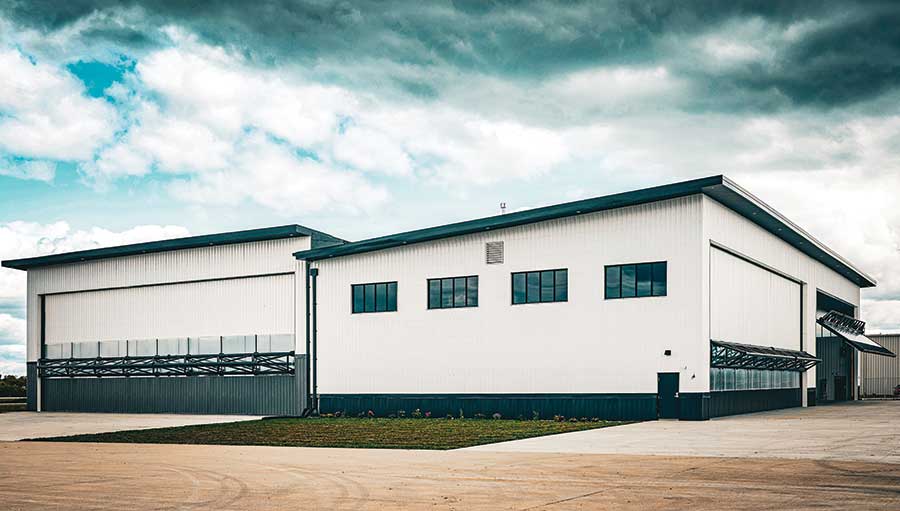
The Kendall Aviation project was the 2026 Light Commercial and People’s Choice Winner in the 2026
ICF Builder Awards. Photo courtesy of Fox Blocks by Airlite Plastics Co.
Insulated Concrete Forms (ICFs) have become one of the most innovative and reliable construction systems available for commercial and industrial buildings. An ICF wall, comprising a reinforced concrete core between rigid foam permanent forms, combines the strength of reinforced concrete with the insulating performance of dense foam. This combination offers numerous advantages over conventional wood-frame, steel-frame, or masonry construction, making ICFs an increasingly popular choice for offices, warehouses, manufacturing facilities, schools, hospitals, retail centers, and government buildings.
Let’s walk through these advantages.
Exceptional Structural Strength
A huge benefit of ICF construction is its remarkable structural strength. Reinforced concrete has long been recognized as one of the strongest building materials available, and ICF systems take full advantage of this characteristic.
Commercial and industrial buildings are frequently designed to support heavy structural loads from equipment, storage systems, machinery, and large roof spans. ICF walls provide outstanding load-bearing capacity while resisting bending, compression, and shear forces far better than many non-ICF construction methods.
Because the reinforced concrete core is continuous, ICF buildings can withstand significant stresses without compromising structural integrity. This strength allows architects and engineers to design buildings that perform reliably for decades with minimal structural maintenance.
Superior Disaster Resistance
Commercial facilities represent significant investments, making resilience against natural disasters extremely important. ICF walls can withstand hurricane-force winds exceeding 200 mph when appropriately engineered. Their solid reinforced concrete construction provides excellent resistance to flying debris that often damages conventional buildings during severe storms.
Earthquake resistance is another major advantage. The reinforced concrete core creates a rigid yet durable structure capable of absorbing seismic forces. Many ICF buildings have successfully survived major earthquakes with minimal structural damage.
Fire resistance is equally impressive. Concrete does not burn, and the foam insulation used in modern ICF systems is treated with fire retardants and cannot support a flame. Depending on wall thickness and assembly, ICF walls commonly achieve fire ratings of two to four hours or more, helping protect occupants, equipment, and valuable inventory.
Flood resistance is also superior. Unlike wood framing, reinforced concrete does not rot, warp, or become structurally weakened after water exposure. After proper cleaning and drying, ICF buildings can return to service much more quickly following flooding.
Outstanding Energy Efficiency
The continuous insulation found on both sides of the concrete core greatly reduces thermal bridging, which is a common source of heat loss in non-ICF construction. At the same time, the concrete’s thermal mass stores heat and releases it slowly, reducing indoor temperature fluctuations throughout the day. The result is lower heating and cooling costs, often reducing energy consumption by up to 60% compared to non-ICF buildings, depending on climate, building design, and HVAC systems.
For commercial facilities operating around the clock, such as hospitals, manufacturing plants, hotels, and office buildings, these savings accumulate continually, significantly lowering operating costs over the life of the building.
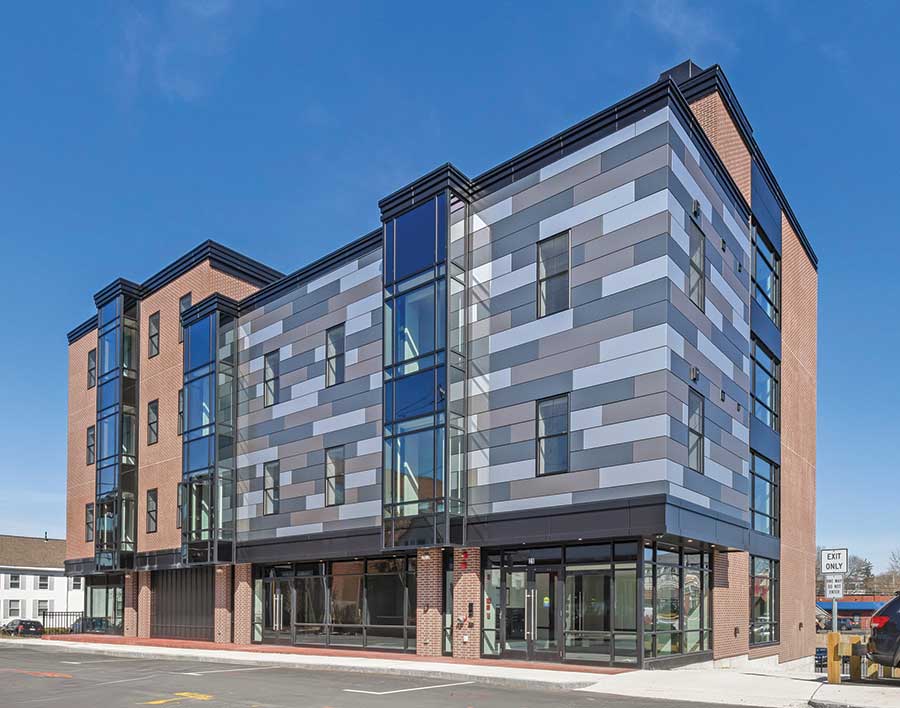
The 21 Summer Street project was the 2nd Runner-Up and People’s Choice Winner in the Heavy Commercial category of the 2026 ICF Builder Awards.
Excellent Indoor Comfort
The continuous insulation minimizes drafts while maintaining stable interior temperatures. Occupants experience fewer hot and cold spots throughout the building, improving comfort for employees, customers, and visitors. The solid concrete walls also help regulate humidity levels and reduce condensation, creating healthier indoor conditions while protecting sensitive equipment and materials.
Superior Sound Control
The combination of thick insulation and solid concrete provides outstanding sound attenuation. ICF walls commonly achieve sound transmission class (STC) ratings exceeding 50, making them ideal for applications where noise control is essential.
Office buildings benefit from quieter work environments. Hotels experience reduced room-to-room noise. Schools enjoy fewer classroom distractions. Manufacturing facilities can better isolate noisy equipment from administrative areas. Improved acoustics contribute to greater employee productivity, customer satisfaction, and occupant comfort.
Long-Term Durability
Concrete is naturally resistant to insects, termites, rodents, mold, and mildew. Unlike wood framing, it cannot rot or decay. The permanent insulation protects the concrete from extreme temperature fluctuations, reducing thermal stress and helping preserve structural integrity over time. Because of their durability, ICF buildings generally require fewer structural repairs and less maintenance than conventional buildings, thus reducing life-cycle costs.
Lower Maintenance Costs
Although the initial construction cost of ICF buildings may be a small percentage higher than non-ICF construction, owners recover these costs through reduced maintenance and operating expenses. Concrete walls do not require frequent repairs associated with wood framing, such as replacing damaged studs, repairing termite damage, or correcting moisture-related deterioration. The durability of ICF walls also minimizes exterior maintenance, reducing repainting, repairs, and structural rehabilitation over the building’s lifespan.
Faster Construction in Many Projects
Modern ICF systems have become increasingly efficient to install. Because the insulation and concrete forms are combined into a single activity, several non-ICF construction steps occur simultaneously. For example, building wrap vapor barrier for wood-frame construction is eliminated, in addition to a separate activity to install insulation. The lightweight permanent forms and installed reinforcing concrete core provide, in one operation, what would require several activities for non-ICF construction.
Many contractors report shorter construction schedules once crews become experienced with ICF installation. Faster completion allows commercial facilities to begin operations sooner, reducing financing costs and accelerating revenue generation.
Environmental Sustainability
ICF construction supports environmentally responsible building practices in several ways. Lower energy consumption reduces greenhouse gas emissions throughout the building’s operational life. The durability of reinforced concrete extends building service life, reducing the need for replacement construction and conserving natural resources. Many ICF buildings qualify for green building programs because of their energy efficiency, durability, indoor environmental quality, and resilience.
Design Flexibility
ICF walls can be curved, of varying heights, have large openings, decorative finishes, and complex building geometries. Exterior finishes may include brick, stone, stucco, fiber cement panels, metal cladding, or architectural concrete finishes. Interior finishes are installed much like conventional drywall construction, while the embedded fastening strips within the forms simplify attachment of drywall and finishes. This flexibility allows architects to create visually attractive commercial buildings whilst preserving superior energy performance.
Enhanced Security
Security is a major concern for many commercial and industrial facilities. The solid reinforced concrete walls of an ICF building are far more difficult to penetrate than non-ICF wood-framed walls. This increased resistance provides greater protection against forced entry, vandalism, and accidental impacts. Financial institutions, government facilities, schools, healthcare centers, and data centers all benefit from the additional security provided by reinforced concrete construction.
Improved Insurance Value
Because ICF buildings offer excellent resistance to fire, wind, and other natural hazards, many insurance providers recognize their reduced risk profile. Depending on the building type, location, and insurer, owners may qualify for lower insurance premiums or reduced long-term risk exposure. Even when premium reductions are modest, the improved resilience can significantly reduce uninsured losses and business interruption following severe weather events.
Strong Return on Investment
While ICF construction may require a modest increase in upfront construction costs compared with non-ICF construction systems, the long-term financial benefits are often substantial. As mentioned above, owners benefit from lower utility bills, reduced maintenance expenses, longer building life, improved occupant comfort, increased disaster resilience, and potentially lower insurance costs. These advantages contribute to a lower total cost of ownership over the building’s lifetime.
For commercial developers, investors, and facility owners, this combination of durability and efficiency frequently results in an excellent return on investment.
Conclusion
Insulated Concrete Forms represent one of the most advanced building systems available for commercial and industrial construction. Their combination of reinforced concrete strength, continuous insulation, exceptional energy efficiency, superior disaster resistance, excellent sound control, and long-term durability creates buildings that are safer, more comfortable, and less expensive to operate over time.
As businesses seek facilities that are resilient, sustainable, and cost-effective, ICF construction continues to gain popularity across numerous industries. Whether used for office buildings, warehouses, healthcare facilities, schools, manufacturing plants, hotels, retail centers, or government buildings, ICFs deliver lasting value by combining structural performance with operational efficiency. For organizations planning facilities that will serve for generations, Insulated Concrete Forms provide a construction solution that meets the demands of modern commercial and industrial building design and construction.

Dave Gowers
After graduating from UK’s London University in 1969, Dave Gowers acquired extensive experience in concrete construction through a diversity of commercial, residential, and industrial projects, up to $1 billion in value, and in several countries. He is well-versed in concrete formwork and shoring systems, and over the past 20 years has produced structural design solutions for over 200 ICF projects, both residential and commercial. Dave resides in Southern Oregon with his wife and business partner, Jennifer. Dave holds a PE license in 15 states/territories, is the principal of Dave Gowers Engineering LLC, and is the co-principal of Cascade ICF LLC. His website is www.dgengineering.com and he may be reached at 541-660-9661 or dave@dgengineering.com.